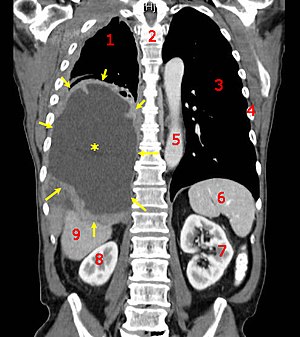
 What is Mesothelioma?
Mesothelioma is a form of cancer that is almost always caused by previous exposure to asbestos. In this disease, malignant cells develop in the mesothelium, a protective lining that covers most of the body's internal organs. Its most common site is the pleura (outer lining of the lungs and internal chest wall), but it may also occur in the peritoneum (the lining of the abdominal cavity), the heart,[1] the pericardium (a sac that surrounds the heart) or tunica vaginalis.
Most people who develop mesothelioma have worked on jobs where they inhaled asbestos particles, or they have been exposed to asbestos dust and fiber in other ways. Washing the clothes of a family member who worked with asbestos can also put a person at risk for developing mesothelioma.[2] Unlike lung cancer, there is no association between mesothelioma and smoking.[3] Compensation via asbestos funds or lawsuits is an important issue in mesothelioma (see asbestos and the law).
The symptoms of mesothelioma include shortness of breath due to pleural effusion (fluid between the lung and the chest wall) or chest wall pain, and general symptoms such as weight loss. The diagnosis may be suspected with chest X-ray and CT scan, and is confirmed with a biopsy (tissue sample) and microscopic examination. A thoracoscopy (inserting a tube with a camera into the chest) can be used to take biopsies. It allows the introduction of substances such as talc to obliterate the pleural space (called pleurodesis), which prevents more fluid from accumulating and pressing on the lung. Despite treatment with chemotherapy, radiation therapy or sometimes surgery, the disease carries a poor prognosis. Research about screening tests for the early detection of mesothelioma is ongoing.
Doctor Explains Mesothelioma Symptoms, Diagnosis & Treatment Video
Comments
Post a Comment